
Cyprus introduces 8% flat tax on gains from crypto assets
On 31 December 2025 Cyprus published in the Official Gazette an extensive package of tax reform laws, including the Income Tax (Amending) (No. 4) Law of 2025, which inserts a new Article 20E into the Income Tax Law (Law 118(I)/2002, as amended).
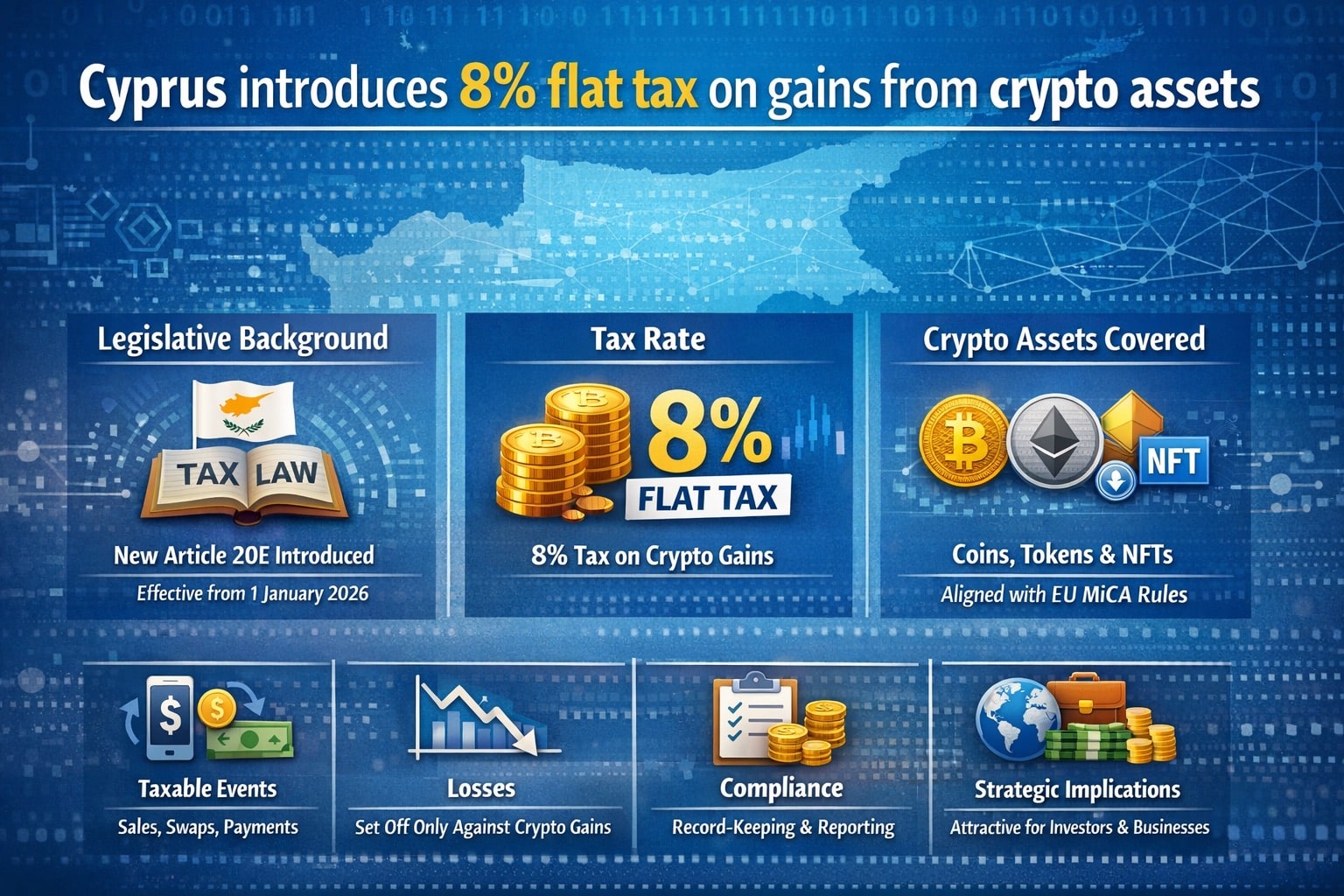
Article 20E creates, for the first time, a dedicated statutory regime for the taxation of profits from crypto assets, subjecting gains from their disposal to a flat income tax rate of 8 per cent with effect from 1 January 2026 (tax year 2026 onwards).
This note summarises the main features of the new regime and outlines practical implications for individuals, companies and crypto-native businesses considering Cyprus as a base.
Cyprus introduces 8% flat tax on gains from crypto assets
Legislative background and effective date
The 8 per cent crypto tax forms part of the broader “tax reform” package that was approved by the House of Representatives in December 2025 following public consultation and social-partner input, and subsequently published in the Official Gazette (Annex I(I), No. 5070, 31 December 2025).
Key contextual points are the following.
-
The reform modernises the Income Tax Law, increases the general corporate income tax rate from 12.5 per cent to 15 per cent, revises loss-carry-forward rules to seven years, and amends the Special Defence Contribution framework for dividends and rental income.
-
Within this wider package, Article 20E introduces a special method of taxation for “profits arising from the disposal of crypto assets” at a flat 8 per cent.
-
The new provisions apply to profits realised in tax years beginning on or after 1 January 2026. Disposals prior to that date remain subject to the pre-existing practice under the Income Tax Law and Capital Gains Tax Law.
Legal basis: new Article 20E of the Income Tax Law
New Article 20E, under the side-heading “Profits from transactions in crypto assets”, provides in essence that:
-
“Profits of any person arising from the disposal of crypto assets shall be subject to tax at the rate of eight per cent (8%).”
-
Notwithstanding the general loss rules of Article 13, losses from the disposal of crypto assets may be set off only against profits from the disposal of crypto assets, and only within the same tax year.
-
The profit that is taxed at 8 per cent is not aggregated with other income of the taxpayer.
Article 20E applies to “any person”, so individuals and legal persons (companies and other taxable entities) are equally within scope.
The territorial scope (world-wide income for Cyprus tax residents and Cyprus-source income for non-residents) is not altered by Article 20E and continues to follow the general rules of the Income Tax Law.
What is a “crypto asset”
The amending law aligns the tax definition of “crypto asset” with the EU Markets in Crypto-assets Regulation (MiCA), Regulation (EU) 2023/1114.
In summary:
-
“Crypto-assets” are digital representations of value or rights that can be transferred and stored electronically using distributed ledger technology or similar, and that do not fall within existing EU financial instruments or e-money regimes.
-
The definition is broad and encompasses, in principle, asset-referenced tokens, e-money tokens and other crypto-assets under MiCA, provided they are not already taxed under a different specific regime.
In practice, the 8 per cent regime is expected to cover, among others:
-
Bitcoin, Ether and other layer-1 / layer-2 coins
-
Stablecoins and other MiCA-regulated tokens
-
Exchange tokens and utility tokens
-
Many non-security NFTs and similar digital collectibles, provided they fall within the MiCA-style definition of a crypto-asset rather than financial instruments under MiFID II
The statutory cross-reference to MiCA is significant. It ensures that tax treatment develops in step with EU regulatory definitions rather than ad-hoc domestic terminology, and it reduces the risk of double classification.
What counts as a “disposal” of crypto assets
Article 20E taxes profits arising from the “disposal” of crypto assets. The accompanying materials and professional guidance indicate that the following events are intended to constitute disposals for the purposes of the 8 per cent tax.
-
Selling crypto for fiat currency (for example EUR, USD, GBP).
-
Exchanging one crypto asset for another (for example swapping BTC for ETH or for a stablecoin).
-
Using crypto to pay for goods or services (for example paying a supplier in USDT or using a crypto debit card where the underlying crypto is liquidated).
-
Donating or gifting crypto assets, including transfers without consideration to related parties, except to the extent that another specific exemption applies.
-
Any other form of disposal that extinguishes or transfers ownership of the crypto asset, including certain redemptions or buy-backs.
Each disposal is a separate taxable event. Where a wallet or position is disposed of in tranches, the applicable cost base and gain calculations will need to be determined on a transaction-by-transaction basis, with appropriate application of FIFO or other accepted methodologies once guidance is issued.
Taxable profit and the 8 per cent flat rate
Although Article 20E provides the 8 per cent rate, the computation of “profit” follows the general principles of the Income Tax Law, as modified by the specific wording of the new article and any future circulars.
In outline:
-
Taxable profit equals disposal proceeds minus allowable acquisition cost and directly related expenses (for example certain transaction fees and brokerage commissions).
-
The 8 per cent rate is flat. It does not increase with the amount of profit and does not interact with the progressive personal income tax bands.
-
The profit taxed at 8 per cent is ring-fenced. Article 20E(4) provides that the profit subject to 8 per cent is not added to other income of the taxpayer, which avoids pushing other income into higher brackets.
By way of very simple illustration:
-
An individual Cyprus tax resident acquires crypto for EUR 100 000 and later disposes of it for EUR 250 000 in 2026. The profit is EUR 150 000.
-
Under Article 20E the income tax on that profit is 8 per cent, that is EUR 12 000, regardless of the individual’s other income.
This is conceptually distinct from the separate Capital Gains Tax Law, which continues to apply (at 20 per cent) to gains on disposals of immovable property in Cyprus and shares in companies deriving value from such property.
Treatment of losses
One of the most important features of the new regime is the treatment of losses. Article 20E expressly overrides the general loss rules of Article 13.
The position is as follows.
-
Losses from the disposal of crypto assets may be set off only against profits from the disposal of crypto assets.
-
The set-off is limited to the same tax year. There is no carry-forward of unused crypto losses to future years and no carry-back to earlier years.
-
Crypto losses cannot be used to shelter other categories of income (such as trading profits, employment income, interest or dividends).
This asymmetry is deliberate. For sophisticated traders and market-makers the 8 per cent rate is attractive, but the inability to carry forward large bear-market losses may materially affect long-term effective tax rates and modelling.
Mining and other crypto-related income
The special 8 per cent regime does not apply to all possible forms of crypto-related income.
Current materials and preparatory commentary indicate the following approach.
-
Crypto mining
Profits from crypto obtained through mining are carved out from Article 20E and remain subject to the ordinary provisions of the Income Tax Law. In practice, mining is likely to be treated as a trading or business activity, taxed at the normal corporate or personal income tax rates, with the ability to deduct relevant operating expenses and to carry forward losses in accordance with Article 13. -
Staking, yield-farming, DeFi interest and similar returns
These are not “disposals” of crypto assets in the strict sense. Unless structured as disposals or redemptions, they are expected to fall under the general rules on interest, other income or business profits, depending on the facts. -
Derivatives and structured products
Gains on certain crypto-linked derivatives may or may not fall within Article 20E depending on whether the underlying is itself a “crypto asset” and whether the instrument constitutes a separate financial instrument under MiFID II. This is an area where further guidance from the Tax Department would be welcome.
The law also contains what practitioners describe as a “fallback rule”: any crypto-related profits not qualifying under Article 20E are taxed under the normal provisions of Parts III and V of the Income Tax Law.
Interaction with tax residency and source rules
Article 20E does not create a special regime for non-residents. Instead, it operates within the existing framework.
-
Cyprus tax residents (individuals and companies) remain taxable on worldwide income, including worldwide crypto disposals, subject to relief under applicable double tax treaties.
-
Non-residents are taxable only on Cyprus-source income. For purely digital assets traded on foreign exchanges, determining “source” will require a case-by-case analysis based on existing principles such as the place of effective management and control of a trading operation, the location where contracts are executed and, for corporate structures, the tax residence of the vehicle holding the assets.
For international investors using Cyprus companies as holding or trading vehicles for crypto, Article 20E offers a clear statutory 8 per cent rate while preserving treaty access and Cyprus’ broader participation-exemption features for non-crypto investments.
Position before 1 January 2026 and transitional issues
Before the introduction of Article 20E, the Income Tax Law contained no explicit provision for crypto assets. In practice, depending on the factual pattern:
-
Some positions were treated analogously to trading stock, taxed at standard income tax rates (12.5 per cent corporate, progressive rates for individuals).
-
Others were treated as analogous to “securities” or as falling outside the scope of Cyprus tax in certain circumstances, with divergent views in the professional community.
From 1 January 2026, disposals of crypto assets fall squarely within Article 20E. Gains and losses realised before that date remain governed by the prior regime. Careful segregation of pre-2026 and post-2026 positions will be important, both in terms of record-keeping and in preparing tax returns.
Record-keeping and compliance
Although detailed administrative guidance from the Tax Department is expected, certain practical points are already clear from the structure of Article 20E and general compliance obligations.
Taxpayers will need to be able to substantiate, at a minimum:
-
Acquisition dates, quantities and cost base of each crypto asset (including transaction fees).
-
Dates and proceeds of each disposal, including the fair market value in EUR at the time of a crypto-to-crypto swap or use of crypto to pay for goods or services.
-
Classification of transactions as disposals falling under Article 20E or as other forms of income (for example mining or staking).
-
Annual computation of crypto profits and losses, demonstrating that losses offset only crypto gains of the same tax year.
Given the inherent volatility of digital asset prices and the use of multiple exchanges and wallets, many taxpayers will require specialised software or professional support to generate accurate histories and reconciliations.
Strategic implications for investors, founders and Web3 businesses
The 8 per cent crypto tax regime is intended to position Cyprus as a competitive yet regulated EU hub for digital assets.
In our view, the main strategic effects are:
-
For individual investors
High-income individuals who were previously exposed to progressive income tax rates on trading-style crypto activities may benefit from a significantly lower effective rate, at the cost of stricter ring-fencing of losses. -
For professional traders, brokers and market-makers
The flat 8 per cent rate provides planning certainty and can be attractive for proprietary trading desks located in Cyprus, especially when combined with the island’s double tax treaty network and the possibility of structuring other income streams under existing exemptions. The inability to carry forward crypto losses, however, must be factored into risk and capital allocation. -
For crypto founders and Web3 projects
Having a clear statutory regime that cross-refers to MiCA definitions is a significant advantage when structuring tokenomics, vesting arrangements and employee incentives. It simplifies modelling of founders’ exit scenarios and of treasury-management strategies involving disposals of project tokens. -
For CASPs and MiCA-regulated entities
The tax regime sits alongside the emerging MiCA licensing framework for crypto-asset service providers and e-money token issuers. Entities seeking to combine regulatory authorisation with a predictable tax environment may find Cyprus increasingly attractive against other EU jurisdictions where crypto tax remains less codified.
How we can assist
The new 8 per cent crypto regime is a welcome step towards clarity, but it also introduces technical questions on classification, sourcing, loss utilisation and interaction with other income streams.
We can assist with:
-
Analysing whether particular tokens, NFTs or instruments fall within the scope of “crypto assets” under Article 20E and MiCA.
-
Designing appropriate holding and trading structures for individuals, funds and operating businesses, including the interplay with Cyprus tax residency and double tax treaties.
-
Preparing or reviewing models of expected effective tax rates under various market scenarios, taking into account the loss-ring-fencing rules.
-
Assisting with systems and documentation to support accurate gain and loss calculations and audit-ready records.
If you would like to discuss how the new 8 per cent crypto tax may affect your specific circumstances or future projects, our specialist lawyers working alongside our in-house accounting department are available to provide tailored advice under Cyprus and EU law.